Fair Taxation for Everyone!
A Flat Income Tax!
On the very first day in office I will enact legislation to reverse completely all of Justin
Trudeau’s Carbon taxes on everything in this country!!!
But we need a fair taxation code for all Canadians! What exactly is that?
A HISTORY
Throughout Canadian history our taxation code has been driven by Left Wing Politics!
That is… the attitude has been “the more you make, the higher your taxation rate should
be!” That is the thinking behind the “Progressive Tax System”. As far as I’m concerned
there’s nothing progressive about it… I would call it Regressive because it promotes
everything negative in the economy!
Choosing a Progressive Tax is incorrect thinking!
What does this type of thinking promote? It promotes mediocrity. How many times have
you heard Canadians say “There’s no point in taking that raise or making more money…
I’m just going to get taxed more and take home the same pay anyway!”
And they’re right! Under the current federal Canadian tax code it works like this:
If you make $53,359 (the original amount for this example) or less you pay 15% tax
If you make $106,717 you pay 20.5% on income above the original amount
If you make $165,430 or less, you pay 26% on income above the original amount
If you make $235,675 or less, you pay 29% on income above the original amount
If you make more than $235,675 you pay 33% tax!
IN THIS EXAMPLE, THE MORE YOU MAKE, THE LESS YOU TAKE IN TERMS OF PERCENT. THIS
PROMOTES MEDIOCRITY!
THE SOLUTION - A FLAT TAX FOR EVERYONE
What is a Flat Tax? It is the same taxation rate for every person in Canada… the same
percentage of your income no matter how much you make.
Why is a Flat Income Tax the best system?
1)
It promotes hard work, ingenuity and success! This is because you know exactly how
much you will make in profit and you don’t get penalized for making more money, you
get rewarded!
2)
It is incredibly simple to calculate.
3)
It allows very successful individuals to provide better for their families, open personal
businesses and expand their businesses because they have more capital to work with.
4)
It reduces the cost of goods in the economy because you have more dollars being
spent since you have more dollars to begin with… providing the country with a robust
economy!
5)
When those who are well off financially save money in taxes, their businesses can
employ more Canadians, reducing the unemployment rate!
6)
A Flat Tax is an incentive to work. When everyone is taxed the same rate, the more
you work, the more you make. But if you charge no tax to those making less…they
will be less likely to work… this system promotes laziness among the people.
Combine this with a system where there is less “free money” handed out by the
government and you will have a strong workforce with people taking pride in their
work.
7)
The Progressive Tax System is liked by many on the Left who don’t want to work and
are jealous of the rich who put in long hours or who work “smarter, not harder”.
Some of these jealous types hate the fact that they don’t have the motivation to be
successful since they’ve developed bad habits in life. So the Flat Tax is great for those
who are self-motivated.
8)
A Flat Tax allows individuals to have greater savings for a house, car, or retirement. It
gives them more income to invest in whatever way they choose.
9)
A Flat Tax means that all Canadians contribute to their country. Nobody gets a free
ride.
10)
A Flat Tax would allow a person to accurately predict their year end income quite
easily and therefore plan for future expenditures.
TRUDEAU HAS DESTROYED OUR ECONOMY FINANCIALLY
During the Plan-demic, Justin Trudeau and other Globalists bent on destroying their
countries said the Plan-demic presented them with an opportunity to reset the world.
It took over 150 years to accumulate the national debt that Canada had at the start of the
Plan-demic. In just 6 months Justin Trudeau with giving out money like it was candy,
doubled the Canadian National Debt… a legacy that will be given to your children,
grandchildren and those who come after them!
WE NEED TO GET THE ECONOMY GOING BUT ALSO NEED TO PAY DOWN TRUDEAU’S
RIDICULOUS DEBT
Our proposal is a 25% Flat Tax for everyone for the first two years while we also create
infrastructure projects to create jobs and expand the Canadian Military.
This tax will spur the economy and get people working!
In order to pay down Trudeau’s debt, we may have to raise sales taxes on certain things.
For example, what things are not good for people? Candy is an example. You don’t want
your kids eating candy all the time and rotting out their teeth. So a health tax could be
put on candy while possibly a reduction in tax on healthy foods! That is just one example.
More on this later! The bottom line is to promote healthy things for all Canadians!
CLOSING TAX LOOPHOLES
Let’s face it… the financially savvy know how to play the tax code! That’s because of tax
loopholes in the code itself. The Freedom Party of Canada will make sure all tax loopholes
are closed so that every Canadian pays their fair share and nobody gets off the hook
while others are doing their part to return the economy to a strong robust one!
PENALTIES FOR INVESTING YOUR MONEY OFF SHORE OR OUT OF COUNTRY AND NOT
PAYING TAX ON IT!
Again there are some, who find loopholes in the code or who bypass the code altogether
to try and cheat the system. Some invest their money off shore. Some invest their money
out of country. But if they made that money here in Canada, they better damn well pay
their fair share of tax on it to the Canadian government! Or they will receive stiff fines
and penalties!
Click the image below to watch a video showing how corrupt the Liberal Carbon Tax is!
It appears the Finance Minister Chrystia Freeland can’t do math! She seems to think
Canadians are getting a good deal with the Carbon Tax when Trudeau is taking away more
than they give back. Polievre destroys her in the video above!
House Defeats Poilievre’s Non-Confidence Motion Over Carbon Tax Hike
(Epoch Times, 3/21/2024)
The House of Commons rejected the Conservative Party’s proposed non-confidence
motion related to the upcoming carbon hike with a vote of 204 to 116 on March 21.
The attempt to bring down the government, described by the Tories as allowing
Canadians to vote in a “carbon tax election,” comes as the Tories have decried the 23
percent hike for the federal carbon tax come April 1.
Earlier in the day, Mr. Poilievre spoke on his motion and said raising carbon pricing by 23
percent will hurt Canadians who are already struggling financially.
“We cannot in good conscience stand by while this prime minister imposes more misery
and suffering on the Canadian people,” Mr. Poilievre told the House of Commons.
The Liberals have long claimed that eight in 10 Canadian households will receive more
from the benefit than they pay out in carbon tax.
Mr. Poilievre has argued, citing figures released by the Parliamentary Budget Officer, that
most households will see a net loss from the carbon tax even with the rebates taken into
account.
Other parties in the House have been steadily voting in block on the issue, with the Bloc
Québécois and the NDP strongly supporting the carbon tax.
The April 1 carbon tax increase is expected to have an immediate impact at the pump in
most provinces. The current surcharge of more than 14 cents will rise to more than 17
cents per litre of gasoline.
Justin Trudeau….bankrupting Canada….one day at a time!
Majority of Canadians Support Saskatchewan in Not Collecting Carbon Tax on Home
Heating (Epoch Times, 3/26/2024)
More than half of Canadians say Saskatchewan is doing the “right thing” by refusing to
collect the carbon tax on home heating, a new survey has found.
“A majority of Canadians (not just Saskatchewan residents) say our government is doing
the right thing by not collecting and remitting the Trudeau-NDP carbon tax on home
heating,” Mr. Moe said in a March 25 social media post.
Support for Saskatchewan comes just days before the carbon tax is set to rise from $65 to
$80 per tonne. The $15 increase is slated for April 1.
Mr. Trudeau has maintained that four out of five households in federally carbon-taxed
provinces earn more back in rebates than they pay in taxes. Canadians do not agree. The
poll found that 45 percent of Canadians believe they pay more in taxes than they receive
back in rebates.
“With affordability a high priority, support for the carbon tax is likely further hindered by
the majority belief that it is making life more expensive for Canadians,” the poll authors
wrote.
Fifty-six percent of respondents said that cost-of-living concerns should be the
government’s priority, even if that comes at the expense of climate change policies. Those
between the ages of 35–64 were especially adamant about that point with 63 percent of
respondents in that demographic listing cost of living as the higher priority.
ANALYSIS: Getting Poorer or Richer? A Look at the Claims Around the Carbon Tax
(Epoch Times, 3/27/2024)
Parliamentary Budget Officer Yves Giroux (an independent officer) said the following:
Mr. Giroux said the carbon tax, like any tax, has an impact on the entire economy. It
reduces economic activity in some sectors, such as oil and gas and transportation.
With the carbon tax, also known as the fuel charge, expected to rise from $65 per tonne of
greenhouse gas (GHG) emissions to $80 per tonne on April 1, then to $170 per tonne in
2030, Mr. Giroux said it will “have a negative impact on a few sectors—some would say
many sectors.”
He said this will lead to lower employment as well as lower corporate profits, which
means lower dividends or lower returns on investments. “And any household that has
shares, either directly [through their investments] or indirectly through their pension
plans, will see ... this lower investment income, and some of them will see lower
employment earnings,” he added.
“Once you take these into account, then it’s the reverse 80 percent—about 80 percent of
the households are worse off with the carbon tax than without,” he said.
Mr. Guilbeault (Liberal whacko Environment Minister) declared himself a “proud socialist”
in the House of Commons in November 2023 after Conservative MP Ted Falk said the
“costly carbon tax coalition” included the “socialists, the separatists, and this prime
minister,” in reference to the NDP and Bloc Québécois supporting the Liberals’ measure.
This guy below (Guilbeault)…
Is actually this guy….
And he went to jail for doing this…. Illegally scaling the wall of the CN Tower
Do you trust this whacko? He broke the law. Total Whack Job!
Is it any surprise Trudeau has ex-criminals in his Cabinet?
4 Premiers to Testify Against Carbon Tax Hike at Parliamentary Committee
(Epoch Times, 3/27/2024)
The premiers of Alberta, New Brunswick, Nova Scotia, and Saskatchewan shared on social
media this week letters they had written to the House Finance Committee requesting a
chance to testify about the impending carbon price hike.
The premiers’ letters described the upcoming 23 percent increase that will see carbon
pricing rise from $65 to $80 per tonne as “punitive” and “disastrous” for Canadians.
“Since Canada’s carbon pricing system was first introduced in 2019, we have made it clear
that we are open to working with any and all provinces and territories that want to
establish their own pricing systems,” Mr. Trudeau said in a March 26 letter posted on
social media.
Trudeau’s idea of working with the provinces: “If you do exactly what we want you to do,
we’ll support you”… what a hypocrite!
Alberta Premier Calls for Ottawa to Suspend ‘Reckless’ Carbon Tax Increase During
Parliamentary Committee Testimony (Epoch Times, 3/28/2024)
Appearing before a parliamentary committee, Alberta Premier Danielle Smith called for
the federal government to suspend the April 1 carbon tax increase, calling it a “reckless”
policy that is creating a crisis of Canadian unity.
“Albertans and all Canadians need common sense compassion and responsible
government to prevail. So I’m urging you today to heed the calls of Canadians across the
country and suspend the increase in the carbon tax on April 1,” Ms. Smith said in her
opening remarks to the Committee on Government Operations and Estimates on March
28.
“This isn’t just reckless. It’s immoral and it’s inhumane, and the added pressure will ruin
countless lives, futures, and dreams.”
You are so right Premier Smith…. Thank God for her as Premier of Alberta to have
someone to stand up to the corrupt, immoral Justin Trudeau! She is so right… he lacks in
compassion, common sense and responsible government! His actions are immoral and
inhumane! Bang on Danielle!
Small Businesses Say They’re ‘Crushed’ by Rising Costs, Call for Halt to Carbon Tax Increase
(Epoch Times, 3/28/2024)
Canadian small businesses say they are suffering under the federal carbon tax program
and are calling on the government to stop the tax hike planned for April 1.
“Small businesses are being crushed by rising costs on all fronts, and the upcoming April 1
carbon tax increase will only add salt to the wound,” said an email statement to The
Epoch Times from Jasmin Guenette, vice president of national affairs for the Canadian
Federation of Independent Business (CFIB).
“Businesses across all sectors are being impacted by the carbon tax, including those in
agriculture, natural resources, manufacturing and transportation,” she said.
The federation says 56 percent of small firms will need to raise prices if the carbon tax
increases. It also noted that 45 percent of small businesses will need to freeze or reduce
wages, and 33 percent have said the increased costs will hurt their ability to invest in
environmental initiatives.
“The giant hike in carbon taxes further highlights how unfair this tax is for small
businesses,” CFIB president Dan Kelly said.
CFIB has started an online petition calling on Finance Minister Chrystia Freeland to pay
out the carbon rebate to small businesses across the country. The document also asks
that the carbon tax remain at its current level.
In February, the federal government announced it was going to reduce the amount of the
rebate for small businesses from 9 percent to 5 percent, according to the Canadian Press.
It also said it intends to return $623 million in carbon tax rebates to businesses for 2024-
2025, down from $935 million in 2023-2024.
Note: As in the pandemic, the true goal of the Trudeau Government is to destroy small
businesses in Canada. The Freedom Party of Canada will put in measures that strengthen
small businesses and encourage the creation of new ones in Canada!
Click the image below to see how the Premiers are Storming Parliament over Trudeau’s
April Fool’s Joke on Canadians by Raising the Carbon Tax 23%
Everyone is against Trudeau and his useless carbon tax which, even if you believe carbon
raises temperature (which it doesn’t…it’s a Hoax), Trudeau’s Carbon tax has not reduced
any emissions in Canada at all… it is essentially useless based on it’s original purpose… it
is just a major tax grab at Canadians to cripple the economy and make life miserable for
all Canadians! What an evil man! The Globalist puppet!
Majority of Canadians Support Saskatchewan in Not Collecting Carbon Tax on Home
Heating (Epoch Times, 3/26/2024)
More than half of Canadians say Saskatchewan is doing the “right thing” by refusing to
collect the carbon tax on home heating, a new survey has found.
Fifty-four percent of those polled by Angus Reid say they support the actions of Premier
Scott Moe and his Saskatchewan Party, with the majority of Canadians in every province
except Quebec on board.
“With affordability a high priority, support for the carbon tax is likely further hindered by
the majority belief that it is making life more expensive for Canadians,” the poll authors
wrote. “Two-thirds said either the carbon tax is making their life “a lot” (40 percent) or “a
little” (26 percent) more costly. Fewer than one-in-five (18 percent) say it makes no
difference to their day-to-day expenses.”
Fifty-six percent of respondents said that cost-of-living concerns should be the
government’s priority, even if that comes at the expense of climate change policies.
Anthony Furey: Trudeau Will Cling to the Carbon Tax Until the Bitter End
(Epoch Times, 3/22/2024)
The federal carbon tax is a “dead man walking.” The much-loathed tax has never had
more public and political opposition than it does now. But don’t expect Prime Minister
Justin Trudeau to ever abandon what’s become his defining policy.
There are now seven provincial premiers calling on Trudeau to pause hiking the carbon
tax as planned on April 1. This increase will cause the price of gas to rise by an extra 3
cents, on top of other changes. And an increase in gas prices will cascade down to affect
the price of food and other basic goods.
The seven are Doug Ford (Ontario), Danielle Smith (Alberta), Scott Moe (Saskatchewan),
Blaine Higgs (New Brunswick), Tim Houston (Nova Scotia), Dennis King (Prince Edward
Island), and Andrew Furey (Newfoundland and Labrador).
While six of them are leaders of conservative parties, Furey (no relation) is a Liberal
premier. That’s the most damning name on the list for Trudeau, given how the Atlantic
provinces have typically been strongholds for the Liberals for decades.
Trudeau is a true believer in these aggressive climate change policies, no matter the
harms they bring to our economy. We should expect more policies like the carbon tax
between now and the election, not fewer.
As you can see in the video above, Canadians are rebelling across the country against
Trudeau’s insane Carbon Tax which hurts families in every way and for everything they
purchase!
Canadians Hold Cross-Country Protests Against April 1 Carbon Tax
(Epoch Times, 4/1/2024)
OTTAWA—Canadians across the country on April 1 held protests against the federal
carbon tax increase, a federal policy they say is making life more unaffordable for those
already struggling financially.
Rita Abouarrage, who was present at the protest on Parliament Hill in Ottawa, said she
has been forced to move back in with her parents despite working a full-time job and
being paid more than minimum wage.
“I can’t afford $2,000 for an apartment, and then trying to eat, pay for your vehicle, and
heat and electricity, it’s too much,” she said.
MPs received a 4.4 percent pay increase April 1, meaning their salaries will increase by
$8,500 to surpass $200,000 per year.
Meanwhile the Conservatives, citing Parliamentary Budget Officer figures, have argued
the overall effect of the tax makes eight out of ten Canadians worse off financially during
the cost-of-living crisis and have called for it to be rescinded.
Agriculture industry representative Janet Krayden, a consultant at Crystal Clear
Connections, told Parliament Hill protestors Canadian farmers are “up against the wall”
because of government regulations.
She said the federal carbon tax increases the cost of farmers’ inputs such as fertilizer and
fuel. That cost is then passed on to consumers.
“It hurts the environment too, because the food has to get here somehow, and it will
come in by trucks and planes rather than by growing in our own country,” she said in her
speech.
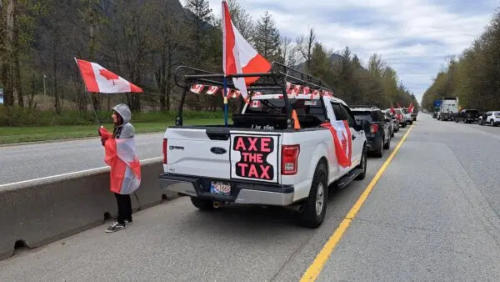
Click on the image below to see an Axe the Carbon Tax Rally
after Trudeau Jacked up the Carbon Tax 23% on April 1st
People have had enough of the lies, the deception and the corruption…and now the
massive inflation. Trudeau cares about one thing only… the Climate Change Hoax!
As you can see….hundreds of rallies across Canada against Trudeau. Will we see a
Trucker’s Rally for Freedom 2 in the near future? Canadians have to stand up to a
Dictator who is pushing false narratives and destroying Canada! Let’s get our country
back!
Half of Premiers Now Want Trudeau to Call National Meeting on Carbon Tax
(Epoch Times, 4/5/2024)
Two more premiers are calling on Prime Minister Justin Trudeau to host a First Ministers’
meeting on the carbon tax.
Saskatchewan Premier Scott Moe and Ontario Premier Doug Ford both released letters
April 5 to request a meeting. The premiers of Alberta, Newfoundland, and New Brunswick
have already done so.
“The Carbon Tax is unaffordable, unfair, and ineffective,” Mr. Moe said in his letter.
“In the interest of fairness for all Canadians, I echo Premier Furey’s, Premier Higgs’ and
Premier Smith’s letters asking you to convene a First Ministers’ Meeting to discuss the
Federal Carbon Tax.”
Saskatchewan stopped collecting the carbon tax on home heating Jan. 1 to protest the
federal move to exempt home heating oil from the tax. The pause primarily benefits
Atlantic Canada. Saskatchewan’s suggestion last fall that the exemption be extended to
include natural gas and other widely used forms of home heating was rebuffed by the
prime minister.
“These amendments by the federal government providing only some Canadians
affordability relief have created unacceptable disparities between households based on
where they live,” Mr. Moe’s letter said.
Ontario Premier Doug Ford said the carbon tax is making life more unaffordable.
Mr. Ford said earlier this week that if Mr. Trudeau doesn’t reconsider carbon tax hikes, he
will lose the next federal election, which must be held by fall of 2025.
Mr. Trudeau appeared to reject any thoughts of a meeting at a news conference in Calgary
April 5.
Click the image below to see a Video in a remote area of Alberta near the BC Border
where people have had enough of Trudeau’s Carbon Tax
Canadians Pay Higher Income Tax Than Workers in Most Other OECD Countries: Report
(Epoch Times, 4/9/2024)
Canadians at all levels of income pay more tax than residents in most other OECD
countries around the world, according to a new report.
The study, “Canada’s Rising Personal Tax Rates and Falling Tax Competitiveness,”
published by the Fraser Institute, said personal income tax rate increases at both the
federal and provincial levels have made Canada less competitive compared with other
countries in the Organisation for Economic Co-operation and Development (OECD).
“In 2022 (latest year of available international data) Canada had the 5th highest combined
top tax rate out of 38 countries,” the report said. “This indicates that in 2022, while
Canada’s top tax rate was more competitive than in four countries, it was uncompetitive
compared to most OECD countries including the United States, the United Kingdom, and
other English-speaking countries such as Australia.”
Countries that ranked higher than Canada for tax rates in the OECD were Japan,
Denmark, France, and Austria.
Five Canadian provinces were in the top 10 spots for highest tax rates in the OECD,
according to the report. These include Newfoundland and Labrador at 54.80 percent, Nova
Scotia at 54 percent, Ontario at 53.53 percent, British Columbia at 53.50 percent and
Quebec at 53.31 percent.
Prince Edward Island landed in the top 15 with 51.37 percent, while Manitoba (51.40
percent), Alberta (48 percent) and Saskatchewan (47.50 percent) were in the “middle
range,” according to the report. These tax rates were higher than those in the United
States (43.30 percent) and the United Kingdom (45 percent).
Two-thirds of Canadians said they pay too much tax, according to an Ipsos poll released in
July 2023. While 39 percent said they pay too much, 29 percent said income tax was “much
too high.” Only one percent said tax rates were too low.
Trevor Tombe: Canada just started the largest tax increase you’ve never heard of
(The Hub, May 16, 2024)
The latest federal budget did little to address Canada’s mounting productivity challenge.
Instead, the government focused on measures that, it argues, will increase “generational
fairness.”
One such move sparked considerable debate: increasing capital gains taxes.
This is an important debate to be had, to be sure, but there are other tax changes coming
that have been completely lost in the shuffle.
A significant increase in taxes on new business investment throughout the Canadian
economy is most concerning of all.
It is likely the largest tax increase you’ve never heard of. And it will lower investment and
productivity at a time when we need more of both.
So what is this tax change? And why does it matter?
It all comes down to how quickly companies can write off capital investments, and to the
2018 corporate tax changes that are now gradually being phased out.
The Trump tax cuts
In 2017, the U.S. implemented significant tax reform. Among many other changes, they
lowered their corporate tax rate from 35 percent to 21 percent and allowed companies to
immediately deduct the full cost of certain capital investments. A company spending $1
million on new equipment could “expense” the full amount immediately, lowering its
taxable income and tax bill.
Before the change, the company would write off this investment over years. And since a
dollar today is worth more than a dollar tomorrow, accelerating the write-offs is
essentially a tax cut.
To understand the impact of these changes, consider one particularly useful measure: the
“marginal effective tax rate” on investment, or METR for short. If a project delivers a 10
percent return before taxes but leaves only 5 percent for the investor after all taxes are
paid, then the effective tax rate is 50 percent—taxes consume half of the investment’s
returns.
Using this measure, the U.S. changes lowered their METR by roughly 11 percentage
points—from 29.8 percent to 18.7 percent. That’s an enormous tax reduction.
Serious analysis suggests this could boost the U.S. economy by 1.7 percent, increase
wages by 1.5 percent, and increase the total capital stock by 4.8 percent, mainly due to
increased investment levels.
Canada’s (temporary) response
Fearing a loss of competitiveness, Canada followed in 2018 by also lowering taxes on new
investments—not through tax rate reductions, but by allowing faster write-offs.
But here’s the catch: these changes were temporary.1
Starting in 2024, they are gradually being phased out and will be fully eliminated after
2027. The incentive to invest in Canada will consequently fall.
Overall, the effective tax rate placed on new investment in Canada is set to increase from
13.7 percent to nearly 17 percent.
Certain types of investment will see even larger increases. The tax on machinery and
equipment investment—a critical source of labour productivity growth—will see an
increase from 5.7 percent to 14.2 percent! And there are differences across sectors, as I
illustrate below.
The effective tax rate in agriculture will increase from 8.1 percent to 11.6 percent, in
construction from 20.8 percent to 22.5 percent, and in services from 17.2 percent to 20.7
percent. The largest increase of all is in manufacturing, which will see the tax on its
investments nearly triple from 3.1 percent to 9 percent.
The consequence: smaller investment returns and, therefore, less investment and capital
for Canadian workers and businesses.
It’s tough to say by how much, but the generic point is not controversial. By reducing the
returns received by an investor, fewer investments will be made. There is considerable
evidence for this. Some estimates suggest that, roughly speaking, a 1 percent increase in
the METR may lower investment by as much as 1 percent or more.
Higher taxes on investment lowers productivity growth
This is crucial for productivity growth since capital accumulation has historically driven
growth.
In a recently published paper for the Canadian Tax Journal and Finances of the Nation,
researchers from the Centre for the Study of Living Standards, Andrew Sharpe and Tim
Sargent, document that since 2000, approximately 90 percent of all labour productivity
gains were from more capital available per worker.
Any serious attempt to boost Canadian labour productivity must improve business
investment incentives. Unfortunately, the coming federal tax changes will do precisely
the opposite.
Rather than reversing the 2018 tax changes, governments could enlarge them.
Look back at the graph above. Even the lower tax rates on investment in construction and
trade are over 20 percent, and services are nearly as high.
We should adopt even more aggressive and expansive measures to lower those rates, as
we’ve done for manufacturing. Provinces too can help, with changes to both corporate
taxes (where provinces operate their own) and sales taxes. British Columbia and
Saskatchewan, for example, levy sales taxes on firm input purchases, which also lowers
returns on investment.
Given Canada’s dismal growth in living standards and real incomes recently, getting the
tax system right is critical. The budget has led many to focus on capital gains. But we
shouldn’t narrowly focus on just one tax change or another; the whole system of raising
public funds in Canada needs a good, hard look.
Justin Trudeau has found another way to “Screw Canadians”, now screwing Canadian
business owners! He is truly hell bent on destroying Canada!
The Freedom Party of Canada will reverse all these taxes and make for a great climate for
small businesses and their investments!

Freedom Party of Canada




- Housing
- Immigration
- Energy
- Health and Drugs
- Our Freedoms
- Freedom of Speech
- Rule of Law
- Farmers
- Military
- Self-Sufficiency
- Protecting Kids
- Prosperity
- Electing Judges
- Electing the Senate
- Sovereignty
- Guns
- Homelessness
- Patriotism
- House of Commons
- Media
- Banking
- Protests
- Vandalism
- Unity and Meritocracy
- Elections
- Special Interest Groups
- Racism
- Self-Defense
- A Flat Tax for Everyone


- Central Bank Digital Currency
- Treason
- Not a Leader
- Liberal Scandals
- Climate Change Hoax
- Globalist Agenda
- Globalist Terrorists
- Ban the UN, the WHO and the WEF
- World Economic Forum
- Green Agenda
- Woke is Dead
- Government Surveillance
- War in Ukraine
- Protests
- Eliminate Harm
- Worldwide Anti-Globalist Organization


© Lorem ipsum dolor sit Nulla in mollit
pariatur in, est ut dolor eu eiusmod lorem


- HOME
- Index-a
- environment
- Index-a
- Index-a
- taxes2
- Index-a
- Index-b
- wokeisdead3
- Wokeisdead-a
- wokeisdead
- wokeisdead4
- wokeisdead5
- wokeisdead6
- Index-a
- Index-a
- Index-a
- Index-a
- Index-a
- Index-a
- Index-a
- Index-a
- Index-a
- Index-a
- Index-a
- Index-a
- Index-a
- Index-a
- Index-a
- Index-a
- Index-a
- Index-a
- Index-a
- Index-a
- Index-a
- Index-a
- Index-a
- Index-a
- Index-a
- Racism-a
- protectingkids2
- Index-a
- Index-a
- Index-a
- Houseofcommons-a
- immigration2
- immigration3
- Index-a
- Index-a
- Healthanddrugs-a
- healthanddrugs3
- healthanddrugs4
- Index-a
- Banking-a
- protests2
- protests3
- Index-a
- Index-a
- Index-a
- housing2
- Index-a
- globalistterrorists2
- Index-a
- Index-a
- Worldorganization-a
- Index-a
- eliminateharm2
- Index-a
- Index-a
- Ourfreedoms-a
- STORE
- climatechangehoax2
- climatechangehoax3
- CONTACT